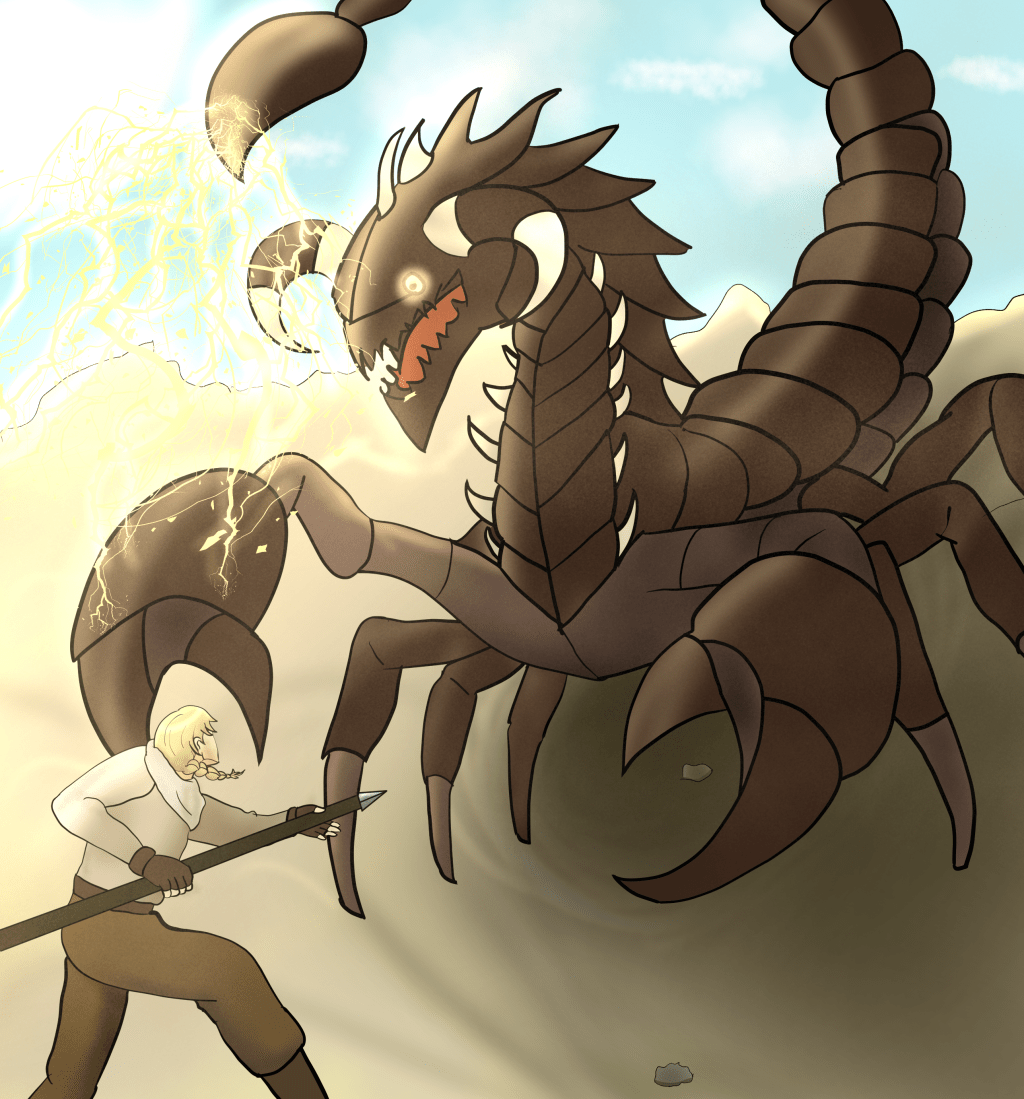
Chapter five of Loyalty Fallen: The Desert Crossing is now available, and you can read it here. In this chapter, Ren and Brenin have an argument that leads to remembering their very rocky history together.
Mild spoiler:
TW for alcoholism and abuse.
That would seem to lead perfectly into the subject of how I’ve chosen to handle difficult thematic concepts in Loyalty Fallen. Please note that I’m not a therapist and your situation is completely your own. This blog post is in no way meant to offer advice or guidance to victims of abuse, but only to describe one way abuse can be handled in fiction.
Dealing with abuse and redemption in medieval fantasy
Loyalty Fallen covers many topics, one of which is an abuser trying to redeem himself.
The person in question who has been abusive in the past is Brenin, the mentor figure for Ren. Brenin’s behavior—striking Ren during and outside of training and forcing him into roles he wasn’t prepared for—represents clear abuse, even if it’s portrayed as typical in many medieval fantasy tropes. In fact, in a historical/medieval context, Brenin wouldn’t be considered an abuser, but rather a somewhat strict father figure.
Brenin knows better. He forced Ren into the terrible situation of having to care for him, clean up after him, and feel responsible when he returned to his alcoholism. This as well as the physical abuse have permanently impacted Ren’s life.
Brenin never denies he is an abuser or claims he deserves forgiveness because he has changed his life. Instead, he’s concerned that the damage he did was so extensive that Ren is incapable of recognizing it.
The strong victim
Ren is a victim. He may not look like it, considering he’s one of the most powerful warriors in the world. But that power isn’t a reflection of his inherent destiny; rather it’s a direct consequence of the abuse he endured. Forced into situations no child should face—abandoned, mistreated, and trained as a soldier—Ren had no choice but to become powerful simply to survive.
As a result, his strength is somewhat tragic. It’s a reminder of the childhood he lost and the abuse that shaped him. Ren was abandoned by his family at a young age, sent to live with someone who didn’t love him and treated him terribly, and was trained as a child soldier of sorts. He killed a man by the time he was 15. The problem is, he doesn’t think any of this has affected him.
Brenin on the other hand clearly sees the results: Ren is incapable of caring for himself before anyone else. He will always put other people’s needs, wants, and safety far above his own, which is why he’s constantly getting wounded.
This is why Brenin dislikes Kathryn and constantly becomes irritated with how Ren is so willing to put himself in harms’ way for her. Brenin sees Kathryn as an extension of the abuse he himself heaped on Ren when Ren was still a child. And Brenin’s one goal becomes helping Ren heal.
Healing from abuse
Brenin believes Ren won’t truly heal from being forced to grow up far too soon unless he understands what has happened to him and that it was wrong. So Brenin’s goal isn’t actually to redeem himself or to find forgiveness, particularly since Ren doesn’t seem to feel forgiveness is needed. Brenin’s only goal is to protect Ren and help him heal, and I think that’s what makes him different from many real-world abusers.
I’m speaking only from the experience of my immediate friends and family members who I’ve spoken to about their abuse experiences, but from what I have seen, abusers may seek redemption as a means to assuage guilt rather than to help the person they’ve abused. They may even put pressure on their victims to “forgive” when either they’ve changed very little or their mere presence is painful to their victims. Rather than helping their victims heal, they may make the situation worse.
Redemption for an abuser?
Brenin, on the other hand, doesn’t believe he has redeemed himself, and he’s not acting merely out of guilt. In fact, while he will apologize, he won’t ask for forgiveness, because he doesn’t believe he’s worthy to do so. He doesn’t want to put any pressure on Ren, and he struggles with the fact that old habits in his manner and speech might hurt Ren further.
Sometimes, the best redemption is just leaving your victim alone to heal on their own rather than trying to force forgiveness. (This is something Brenin attempted in the past, until he heard Ren might be in danger and came running to help). Other times, the best redemption is action and helping as many people as possible to reduce even a little bit of the damage abuse has brought to the world. Regardless, redemption doesn’t have to guarantee forgiveness from the victim.
In the end, Brenin chooses action, which is what leads him to follow his adopted son on a crazy quest around the world, without ever expecting forgiveness. And I think this is exactly what makes it evident that Brenin has, in a very real way, redeemed himself.
Final thoughts
If you are a victim of abuse, whether you believe abusers can ever find redemption or not, I hope you find healing. And I hope you can gather people around you who can help you on that journey.
The holidays can be one of the toughest times of the year for this. If you or someone else you know is in an abusive situation, you can call the National Domestic Violence Hotline at 800-799-7233.
Take care and happy (and safe) holidays!
 Loyalty Fallen Hub
Leave a comment