The latest chapter of Loyalty Fallen is up, so feel free to read it here. If you haven’t yet taken the plunge of reading the first book, take a look at this short video to learn more.
In the meantime, let’s take a look at my top resources for fantasy writers that I’ve come across over the past year. I am not an Amazon affiliate, nor am I sponsored by any of these, so these are genuinely my favorites. As a reminder, please subscribe and like the post if you’ve been enjoying this series that offers resources and tips for writers. It helps a lot.
1. Storyfolk Novel Planners
I’m putting this at #1 for folks who are more planners than pantsers. If you’re a pantser however, Storyfolk also has resources for you in the form of the less-guided and detailed Inspiration Journal.
Storyfolk.ca is a website that also allows you to connect with beta readers or discover stories you may be willing to beta read. The journals and planners are available through Amazon and are specific to various genres. That means you can get a planner specifically for a historical fiction novel. The only one I have used so far is the fantasy novel planner, and out of the three different ones I have tried, it has been the best by far in a few ways:
- Extra pages for notes
- Plenty of options for multimedia expansion through cover art or map making
- Lots of useful prompts and suggestions
- A large section for developing various characters and villains in detail
In short, I highly suggest you check these out if you are interested in keeping track of your characters and world building. Just as a note, one planner is for one novel, so if you’re the type of person who tends to jump from project to project a lot, these may be a bit expensive for you.
2. R/fantasywriters
My recommendation to most writers is that you don’t try to go it alone. Writing is a lonely, frustrating business, and there are many communities available to help make it less lonely.
I put this particular group as my #2 option because it has almost 900k members and is a very active community. There are also subreddits for romance writers and science fiction writers, etc. While there are groups for writers in general, you may have an easier time connecting with people who are already writing similar things.
In r/fantasywriters, you can ask any questions you want about your work, share about what you’re writing and get critiques, and a lot more. Just make sure to follow the community instructions and consider offering help when possible as well.
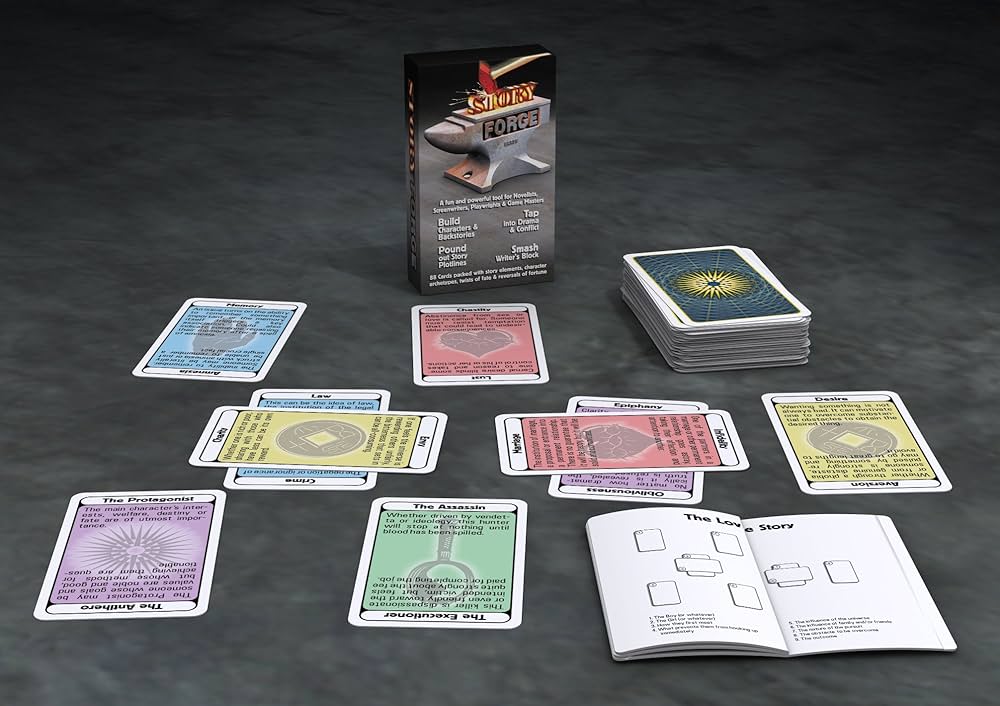
3. StoryForge cards
You can see these at the image at the top of this blog post. I absolutely love these cards, but they can be difficult to find. See if you can get them on Amazon, but if not, there’s a dedicated website. I’m just not sure how trustworthy the website is, because I got mine on Amazon.
That said, I really love these! They’re good for any genre, but the prompts seem to be primarily aimed at fantasy. You can also use them for party games where someone starts off the story based on a card and then the story goes around in a circle with other people.
The card pack comes with a little booklet that offers instructions and various layouts to help with character backstories, villain arcs, and a lot more. I use these for loose inspiration or for fun.
4. Mythic Scribes
If you’ve followed my blog, you know this is one of my absolute favorite websites at the moment. Mythic Scribes is a forum for fantasy writers to ask for critique, share their work, and connect with other writers.
Again, while this is a fantasy-specific forum, you can find these for virtually any genre. From what I’ve seen so far, most of these communities are very gracious and inviting.
5. ChatGPT
ChatGPT is an AI-based chatbot that you can access for free. Before I get into trouble, let me just say I do not think you should write ANY part of your novel using ChatGPT. For one thing, most editors won’t accept it, and you could find yourself banned from critique sites and forums as well. For another, you can easily end up violating copyright, because ChatGPT regularly plagiarizes.
That said, it’s extremely useful for organizing information. I’ll often just blurt out a bunch of details about a character and ask ChatGPT to organize that info into a comprehensive profile, and it does. This is particularly useful for fantasy stories in which you want to do a lot of world building or feature a complex magic system.
6. Pinterest
Consider using Pinterest when you don’t know what to write and just feel bored. Type in the word “drama” or something equally non-specific, like “magic.” You’ll get lots of interesting images that could become the basis for short stories or even entire novels.
I also think that this can be another great way to practice writing descriptions. Find a particularly elegant or interesting image and see how well you can conjure up that image in the mind of another person with your writing. If you’re really brave, have someone read what you wrote before showing them the picture and ask what they expected to see vs. what they actually ended up seeing.
7. Jed Herne’s YouTube channel
Jed Herne is a fantasy author with several books published. He wrote Fires of the Dead and Across the Broken Stars, and he has a YouTube channel where he offers advice and help to new fantasy writers. He also offers resources and paid training at his website. In my opinion, the costs for the training and workshops are way too high, but apparently some people find them worth the money. Fortunately, there’s plenty of useful info you can get for free through the YouTube channel.
Bonus: Three-act story structure
An extremely common way to structure stories, and particularly fantasy stories, is the three-act story structure. Basically:
- Act 1 (Setup)
- Act 2 (Confrontation)
- Act 3 (Resolution)
Act one is meant to introduce the main characters, the world, and the main conflict (inciting incident) that will be at the center of your story.
Act two involves a bunch of challenges facing the characters on their way to resolve that main conflict. There’s also usually a turning point, often brought on by a tragedy or a major mistake, that causes the characters to reevaluate or change their strategy. In fantasy, this will often be the death of a mentor or a favorite side character.
Lastly, there’s the third act, or the resolution, which involves the final battle.
When I want to come up with a new story idea but I only have the bare bones, I take that story idea to the three-act story structure and see if I can add just a few more points to make it have a clear beginning, middle, and end. So I would consider this another resource for fantasy writers.
Final thoughts
Let me know in the comments if you’re already familiar with any of these resources or if you have others that you’d like to mention. Don’t forget to like the post and subscribe if you find this useful or if you’re looking forward to the next post on how to set and track realistic writing goals.
In the meantime, enjoy Loyalty Fallen!
 Loyalty Fallen Hub
Leave a comment