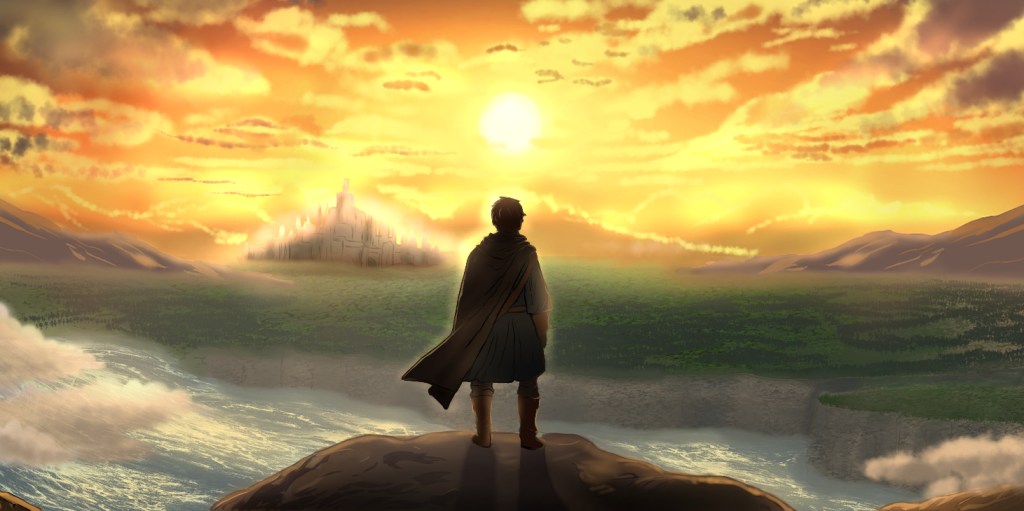
There are just two more days before the first ten chapters of Loyalty Fallen go live, after which the rest of the story will be serialized here on the website one chapter each week. In preparation, I will be publishing a blog post each day to count down to the publication. In this blog post, I’m going to share a little bit about how I came up with the world and characters of Loyalty Fallen. Read on to learn about the three-act story structure, the videos and Youtubers that helped me plan out my story and characters, and other tools that have helped me create this story.
A Fantasy World Without Magic
When I first came up with the idea for Loyalty Fallen, magic was not even an integral part of the world. It was more like an alternative history based in Europe during midieval times.
I had some ideas for the setting. I wanted a story about a princess in an arranged marriage who is accused of killing her husband on her wedding night. I started out with a loose three-act story structure. For those who are unfamiliar, a three-act story structure consists of:
Act 1: The Setup
In the first act, you introduce your characters, setting, and the story’s primary conflict. This act typically ends with the inciting incident – the event that kick-starts the main action.
- Introduction: Meet the characters and understand their world.
- Inciting Incident: Something happens that disrupts the status quo.
- First Turning Point: The protagonist makes a decision that sets the story in motion.
Act 2: The Confrontation
This is where the action really picks up. The protagonist faces obstacles and challenges that test their resolve. It’s the longest act and includes the midpoint – a significant event that changes the direction of the story.
- Rising Action: The protagonist encounters various challenges and setbacks.
- Midpoint: A crucial event that shifts the story’s direction.
- Second Turning Point: Things get even more intense, leading to the climax.
Act 3: The Resolution
The final act wraps up the story. It includes the climax – the most exciting part where the protagonist faces the biggest challenge – and the denouement, where loose ends are tied up.
- Climax: The peak of the story where the protagonist confronts the main conflict.
- Falling Action: Events start winding down.
- Resolution/Denouement: The story concludes, and we see the aftermath of the protagonist’s journey.
Within the confines of this structure, my story began to grow and I created detailed character profiles for each character in a document that was more than a hundred pages long. These character profiles helped me ensure each character had a consistent “voice,” backstory, and features. I created kingdom profiles to figure out the basic topography and political systems that might be relevant in the story.
As I began to write, though, there were a few story elements I was having trouble with. Mainly, I didn’t like my main character.
The Problem With the Protagonist
Kathryn was not a likeable main character initially. She was completely set on her own goals and ways to the detriment of anyone around her. Her goals were selfish and didn’t have great motivations behind them. Wanting power for the sake of wanting power wasn’t enoguh to make her interesting. While I wanted a flawed character who wasn’t a Mary Sue, I didn’t want readers to have to suffer through every scene with her just to get to the much better-developed side characters.
Another problem was that I wanted Kathryn to be a highly intelligent and strategic individual. This plays into the story at various points and was a necessary part of her development, but initially, I couldn’t figure out how to establish her intelligence without just saying “she’s smart.” That didn’t fit with what I’d always heard I was supposed to do in my writing: show, don’t tell.
In the end, I was watching a video essay on YouTube from a very small channel with only around 700 subscribers, Magnifying Moments. The name of the video was “Why Katniss Everdeen Is one of The BEST Characters Ever Written… | (Video Essay).” I’ve never read the Hunger Games, but I had some familiarity with Katniss as a character from hearing about her from other people, and she’d never sounded particularly interesting, until I watched the video and finally realized her appeal. Like Mulan, Katniss’ arc starts with stepping forward to protect a loved one. Regardless of any other flaws the character might portray throughout the rest of the story, that setup is often enough to keep people interested. And suddenly I knew how to fix Kathryn.
Kathryn wants to prtoect her kingdom and her sister. Those are the things that introduce her as a likable character. As for her intelligence, I hope you will see that displayed in actions rather than words in the first part of the book.
When I had the character figured out, I still had a major problem. There were some aspects of the climax that were less than climactic, and as I watched more videos on writing a good climax, I realized I had made some big mistakes in planning it out. However, I had painted myself into a corner with the way I planned out the rest of the story, and I didn’t know how to fix the problem.
A Fantasy World With Magic
My biggest problem was that I didn’t have the tools in my toolbox to make the climax or the world in general particularly interesting or exciting. I began toying with the idea of introducing a hard magic system that would allow me to get my chracters out of seemingly impossible situations without just introducing an entirely new character or plot point out of the blue.
Hard Magic System
A hard magic system is like a set of clearly defined rules and boundaries for how magic works. Imagine it like a well-documented spell book where everything is explained and predictable.
- Clear Rules: The magic has specific, understandable rules. For example, wizards can cast spells but only if they have a certain type of crystal.
- Limitations: There are defined limits to what magic can do. This keeps things balanced and prevents characters from becoming too powerful.
- Predictability: Because the rules are clear, readers can anticipate how magic will be used in different situations. This makes it easy to follow and creates logical consistency.
Brandon Sandersen is a well-known fantasy author who primarily relies on hard magic systems, like in the Mistborn trilogy. In these worlds, magic follows specific principles that characters and readers understand. Characters must work within those confines and use their imaginations to succeed, rather than simply getting a power up or introducing a new spell whenever the story demands it.
Soft Magic System
A soft magic system is more mysterious and less defined. It’s like a misty, enchanted forest where anything can happen, and the magic often feels more like a force of nature.
- Mystery: The rules of magic are not clearly explained. It might feel more like magic is a part of the world rather than a tool that can be controlled.
- Flexibility: Because there are fewer defined rules, magic can be used more flexibly to serve the story. This can create a sense of wonder and unpredictability.
- Impressionistic: Magic in these systems often works to create a mood or atmosphere rather than being a precise tool.
Think of the magic in “The Lord of the Rings” or “Harry Potter.” While there are some rules, much of the magic feels wondrous and mysterious, adding to the sense of adventure. While these stories can be fun, they sometimes fall into what I would consider a trap of relying on the “Deus ex machina.” Deus ex machina means “God from the machine,” and it refers to a plot device in which a seemingly unsolvable problem is suddenly resolved by an unexpected and improbable event.
The term comes from ancient Greek theater. In plays, a so-called god or divine being would be brought onto the stage using a machine (like a crane) to resolve the story’s conflicts. Because the resolution comes out of nowhere, surprising both characters and readers, the solution is often unlikely or not foreshadowed, making it feel a bit like cheating.
For example, in a fantasy book with a soft magic system, it’s easy to simply let your characters win a fight by making them more powerful when they’re angry. In a book with a hard magic system, there are other restrictions in play beyond just the character’s feelings, so the likelihood they can win a seemingly unwinnable fight just by getting emotional is reduced. Instead, the character will have to find a clever workaround, which in my opinion tends to be more interesting to read.
Introducing a hard magic system, which I shared in my recent blog post, turned out to be way more fun and interesting than I could have ever imagined. Not only did it allow me to resolve story issues I hadn’t planned for very well, but it allowed me to make other story beats more interesting. Fights that were confined to two giant men whacking at each other with swords suddenly involved many more participants and factors. Certain female characters that had to be sidelined in a couple scenes due to their personalities and physical attributes suddenly could play a more active role. Magic is the great equalizer, after all.
Beyond the Outline
After refining my chapter-by-chapter outline, I was finally ready to start writing the “final” draft of Loyalty Fallen. The world now included fantastical creatures, magical gems, political systems, and a highly diverse and complex set of characters.
I found myself changing things constantly as I wrote. Some smaller characters had to be cut out because they just didn’t have enough relevance in later parts of the story. I had to move some flashbacks and character development to later chapters, because I had originally shoved it all into the first few chapters. Suddenly I was getting more and more excited about my story.
Now I’ve fully edited Part 1, with the help of some friends. You’ll be able to read the first ten chapters on Tuesday and see the results of all of this prep work. And as a gift to my readers, for the first ten days after the story goes live, I’ll be sharing the following on my blog:
- Tips and tricks on character development/character profiles, including how to use the MBTI personality assessment
- My favorite YouTubers who have helped me get a better understanding of how to develop characters and stories
- My process for choosing a title for a novel
- Common proofreading mistakes to watch out for in your novel
- Worldbuilding tips
- How to create a hard magic system – with examples
- Why you might not want to publish your novel yet
- The art of Loyalty Fallen and a detailed explanation of my art process
- The music of Loaylty Fallen and about the songs and lyrics I’ve written for the story
- How to write a good blurb for your book
After that I’ll be regularly posting short stories related to the characters, more info on the world of Loyalty Fallen, and other tips. Subscribe to stay up to date, and comment below to tell me about your process when you sit down to write a fantasy novel. Do you do a chapter-by-chapter outline or do you use a loose framework? Do you create comprehensive character profiles or do you make it up as you go along? Let me know in the comments!

 Loyalty Fallen Hub
Leave a reply to Top 5 YouTubers for Fantasy Writers to Follow – Loyalty Fallen Hub Cancel reply